Posts

Showing posts with the label symbols

Symbols of Ancient Egypt: Pilar Djed

Image
The Djed pillar, often seen as a symbol of stability, is subject to various interpretations. One prevalent theory suggests that it represents the spine of Osiris, which, according to myth, was magically restored by Thoth and Isis after Osiris's altercation with Seth, thereby granting him renewed use of his legs. Aaron G. Filler posits that this myth could be indicative of the first neurosurgical procedure in history. This interpretation is further supported by the frequent depiction of the pillar on the rear of sarcophagi. Another hypothesis associates the Djed pillar with the column inside which Osiris's sarcophagus was secured in Byblos. While some researchers propose a connection to a tree, the true origin and representation of the Djed remain uncertain. Initially, it may have been an agrarian symbol linked to the deities Sokar and Ptah, which Osiris later adopted. Additionally, there are more speculative theories, such as those suggesting ancient Egyptian contact with extra...

Symbols of Ancient Egypt: Crowns

Image
Contrast of the red (left) and white (right) crowns in an image of a lintel from the Medamud temple currently in the Egyptian Museum in Cairo. Image credits: Hirmer Fotoarchiv, Munich Crowns are among the most significant and recognizable symbols of the Kemet rulers. The tradition of using crowns to signify authority extends deep into prehistory. To visibly distinguish authority, the head was chosen as it is the most visible part of the body even from afar. From the moment the first leader donned a crown to assert power over a group, crowns have been emblematic of monarchy, as well as military and religious leadership. In Ancient Egypt, crowns symbolized the king's power, who, alongside the gods, was entitled to wear it. Various crowns have been utilized throughout the nation's history. This brief overview will cover the most renowned and emblematic crowns, alongside an analysis and examination of numerous other crowns referenced in The Pyramid Texts that merit attentio...

Symbols of ancient Egypt: Ankh (or key of life)

Image
The phrase "the key to life" may sound appealing and profound, and while it garners attention, it's often used colloquially and can be misleading, especially when used to attract tourists or propagate misconceptions. It's important to note that in Kemet (Ancient Egypt), literacy was limited to select groups such as priests and scribes. There were various scripts employed, with hieroglyphics being the most recognized by the public. In this script, words and letters are depicted through symbols or ideograms, similar to other languages like Chinese. For instance, the hieroglyph for 'life' is denoted by a specific symbol: ☥  The term "ankh" is often read as "anj" in Spanish. This discrepancy arises from the varied transliterations used across different languages, such as "anch" in German. The pronunciation "anj" does not imply that "ankh" is an incorrect transcription, nor that it should be pronounced as "ank....

Symbols of Ancient Egypt : Scepters

Image
Today we are going to focus on a specific aspect of Ancient Egypt. The scepters or symbols of power: SCEPTER OR FLAGEL NEKHEH The scepter was an emblem of authority that the king held in his right hand. Its design remained consistent throughout Egypt's history, as depicted on the Narmer Palette. It is predominantly associated with Osiris, though connections to other deities like Min are also evident. There is no clear and concrete idea of what it represented due to the lack of evidence about it. The most widely accepted theories suggest that it represents a symbol of sovereignty with which the king guides his people. Others interpret its shape as that of a modified flail or a cattle prod. It is also associated with the afterlife and is considered the tool with which the deceased are led, connecting its bearer with the deities of the beyond. Another theory * 1 posits that it could be a rattle or an auditory guiding instrument since, in the Narmer Pale...

Symbols of Ancient Egypt: The Legend of the Phoenix Bird

Image
Much has been discussed, and the image of the phoenix bird is widely recognized as the mythological creature that is reborn from its ashes in a perpetual cycle of rebirth. Yet, the origins and symbolism of this creature are not commonly known. To understand its beginnings, one must look to Kemet, known today as ancient Egypt, where a truly unique bird, the Benu bird, was venerated. This avian was intimately linked to the cycle of the underworld or Duat, embodying the 'ba', or soul, of deities such as Ra or Osiris (Usir). The name 'Benu' itself derives from a verb meaning 'to rise'. Legend holds that at the moment of creation, this bird alighted upon a rock amidst the primordial waters and let out a call that shattered the original silence, defining what would come into being. When Greek travelers reached Egypt, Herodotus recorded a variation of this myth. He described the bird as having a lifespan of five hundred years. At the end of its life, it would c...

Symbols of Ancient Egypt: The Uadyet Eye

Image
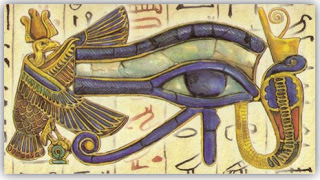
The Uadyet, also known as Wadjet, is one of the best-known symbols of ancient Kemet (Egypt) and yet one of the most misunderstood today. The Eye of Horus is much more than it seems and cannot be limited to a phrase or a concept. First of all, it should be noted that its name is Uadyet, and it has multiple functions: 1- As the current conception of the Eye of Horus (Heru), due to the fact that Heru lost his left eye in the battle with his brother Set (also known as Suti) and it was Thoth (Yehuti) who restored it, returning its functionality, as narrated in formula 17 of the Book of the Dead. At the same time, Heru offered it to his father Osiris (Usir) to restore his sight. However, the eye is not always completely restored. His wounded eye is the moon, which grows as Heru's eye heals to full circumference, decreasing again as the eye weakens. For this reason, it was frequently used as a protective amulet. His right eye is the sun and also known as the Eye of Ra. 2- As a mathematica...